

At a glance
| Lens types | Monofocal (standard), toric, extended depth of focus (EDOF), and multifocal |
| Surgeon | Dr. Relief Jones, III, M.D. performs all of our cataract surgery |
| Consultation | With Dr. Jones or Dr. Triana |
| Where | American Surgery Center of South Texas, 12838 Vista Del Norte, San Antonio |
| Insurance | Standard monofocal lens covered, including by Medicare. Premium lenses and laser astigmatism correction are out-of-pocket upgrades |
| Cost | Laser cataract surgery costs as low as $2,500 per eye; premium IOLs add to this base cost |
| Financing | CareCredit available – Apply online |
| Glasses | Premium lenses can reduce your dependence on glasses, but no lens is perfect and results vary |
Standard vs. premium lenses
Every cataract surgery uses an intraocular lens. Standard monofocal lenses focus at one distance (most people choose far), so you’ll typically still need reading glasses or progressives. They work very well, and many patients are happy with them.
Premium lenses go further. Some correct astigmatism, and some give you a wider range of focus so you can see at more than one distance with less dependence on glasses. In exchange, they cost more, and some can cause glare or halos around lights. There’s no right or wrong choice. What’s best for you may not be best for someone else.
Compare your lens options
| Lens | What it does | Best for | Trade-offs |
|---|---|---|---|
| Monofocal (standard) | Sharp vision at one distance, usually far | Patients happy to wear glasses for reading; the fewest night-vision side effects | Reading glasses or progressives typically needed. Covered by insurance |
| Toric | Corrects astigmatism, usually for far vision | Patients with significant astigmatism who want sharper distance vision without glasses | Reading glasses still typically needed. Out-of-pocket upgrade |
| Extended depth of focus (EDOF) | Extends clear vision from far through the intermediate (computer, dashboard) range | Active patients, computer users, and people who drive at night | Reading small print may still need glasses. Some glare or halos possible, generally fewer than with multifocal |
| Multifocal | Focuses at far, intermediate, and near | Patients who want the most freedom from glasses at all distances | Glare or halos around lights (especially at night) and slightly reduced contrast are possible. Your brain needs time to adapt |
| Toric versions of the above | Combine astigmatism correction with EDOF or multifocal | Patients with astigmatism who also want a wider range of vision | Same trade-offs as the base lens |
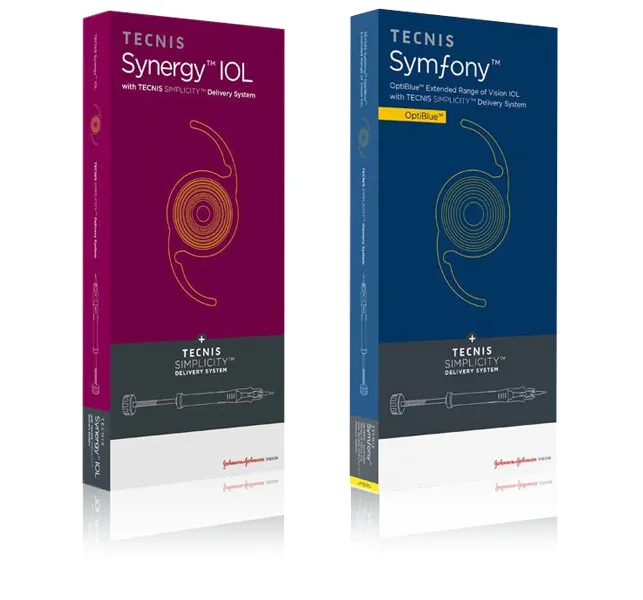
Examples: Alcon PanOptix Pro (also available as Toric), J&J Tecnis Synergy and Symfony (both also available as Toric), Alcon AcrySof/Clareon Toric
Multifocal lenses
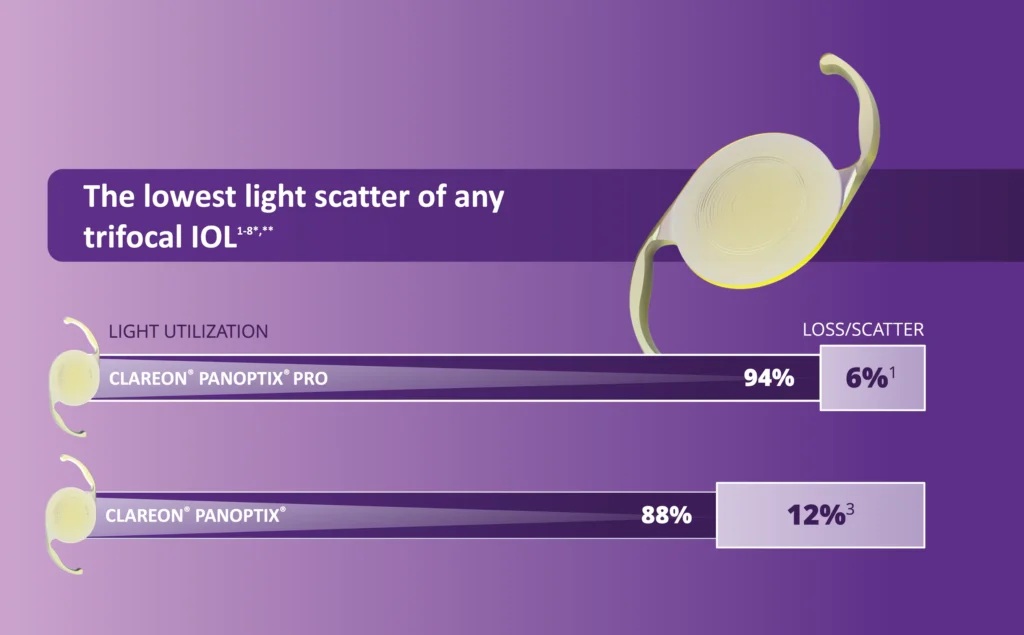
Multifocal intraocular lenses have several focal points, so you can see far away, at intermediate range, and up close, much like progressive glasses. They work by splitting incoming light and directing it to different focal points, and your brain learns to select the image it needs. Many patients can read, use digital devices, and drive with little or no need for glasses.
The trade-offs are real. Splitting light can cause glare or halos around lights, especially at night, and can slightly reduce contrast sensitivity. Some patients’ brains adapt more slowly than others, and improvement can continue for about a year after surgery. Multifocal lenses are not recommended for everyone, including many patients who have had LASIK or who have other eye disease.
Extended depth of focus (EDOF) lenses
Extended depth of focus lenses stretch the focus of light so there’s a longer range of sharp vision, especially from far through the intermediate range, which is ideal for computers, dashboards, and many hobbies. Compared with multifocal lenses, EDOF lenses generally cause fewer glare and halo problems, which makes them a good fit for people who drive a lot at night. They give a wider range of vision than a standard monofocal lens, but you may still want reading glasses for small print.
EDOF lenses can also be a good option if you’ve had LASIK and want to be less dependent on glasses.
Toric lenses
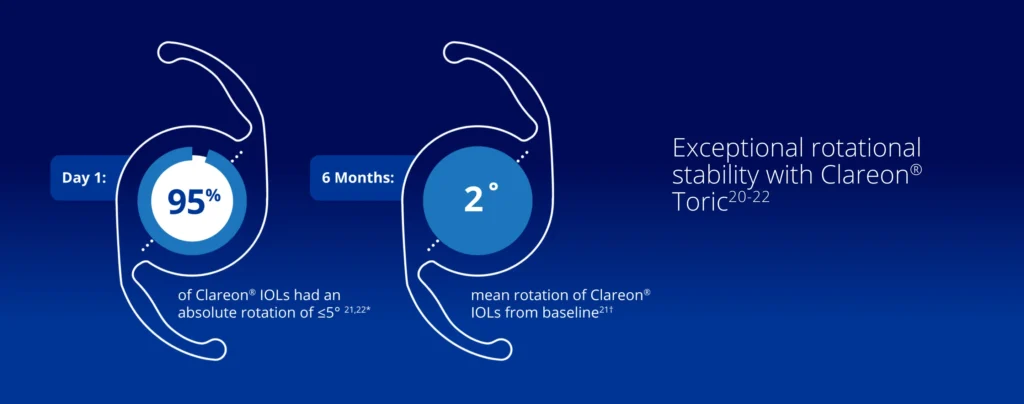
Toric intraocular lenses correct astigmatism, a shape problem in the cornea that blurs vision at all distances. A standard lens has the same strength in every direction; a toric lens has different strengths in different directions, like a toric contact lens, to counterbalance the shape of your cornea. They’re matched carefully to the amount and angle of your astigmatism, and they’re placed precisely.
Lower levels of astigmatism can often be reduced with the laser or with relaxing incisions during surgery, but there are limits to how much astigmatism can be corrected that way. That’s where toric lenses are especially useful. Toric lenses also come in EDOF and multifocal versions.
Lenses we don’t currently offer
- Light-adjustable lenses (LALs) can be fine-tuned with light after surgery, but they function like monofocal lenses (each eye is set to one focal point), and their high cost makes them less attractive for most patients. We don’t offer them at this time.
- Accommodating lenses are designed to move slightly with your eye muscles. They’ve been limited by problems when the lens arms scar in place (called “z-syndrome”) and are not currently available at our office.
What premium lenses can and can’t do
- They can reduce your dependence on glasses, and for some patients eliminate it for most activities.
- They can’t promise perfection. No lens is perfect, results can vary, and a small percentage of patients still need glasses or contacts for their best vision.
- Multifocal and some EDOF lenses can cause glare or halos, and multifocal lenses can slightly reduce contrast. Many patients adapt, but not everyone does.
- Your eye surface matters. Dry eye can affect your measurements and the quality of your vision, especially with premium lenses. We evaluate and treat it before surgery. Learn about dry eye treatment
- Other eye conditions matter. Glaucoma, diabetic retinopathy, macular degeneration, prior LASIK or other eye surgery, and corneal problems can limit your options or make multifocal lenses a poor choice.
Are you a candidate for a premium lens?
You may be a good candidate if your eyes are otherwise healthy, you’d like to depend less on glasses, you have realistic expectations, and you’re comfortable with the possible trade-offs. Patients with significant astigmatism often benefit from a toric lens. People with eye disease, prior corneal surgery, or untreated dry eye may have fewer options, and we’ll tell you honestly if a standard lens is your best choice.
How we choose your lens
- Complete eye exam and measurements. We check your overall eye health, measure your eye precisely, and may use OCT to look at the back of your eye. We also use the ORA system for intraoperative measurements for all premium IOLs.
- A conversation about your life. How much do you read? Work on a computer? Drive at night? What hobbies matter most? How do you feel about wearing glasses?
- Treating dry eye first, if needed.
- Your recommendation. Dr. Jones or Dr. Triana explains the lenses that fit your eyes and goals, including the trade-offs, and you decide together.
Laser cataract surgery and premium lenses
You don’t need the laser to have a premium lens, but many patients choose it because of its added precision, especially with toric and multifocal lenses. Dr. Jones will tell you honestly whether he recommends the laser for your eyes. Learn about laser cataract surgery
What the surgery is like
Premium lens surgery is the same as standard cataract surgery. It’s an outpatient procedure: your eye is numbed and you receive IV sedation, the cloudy lens is removed through a small incision, and your new lens is placed in the same spot, usually without stitches. The surgery itself usually takes 15 to 30 minutes, though you’ll be at the surgery center for 2 to 3 hours. You’ll use antibiotic and anti-inflammatory drops, wear an eye shield when sleeping for the first week, and be seen the day after surgery and again about a week later.
Cost, insurance, and financing
| Option | Insurance | Your cost |
|---|---|---|
| Traditional cataract surgery with a standard monofocal lens | Covered, including by Medicare | Your deductible and copay [plan-dependent] |
| Laser cataract surgery with a premium lens | The laser, astigmatism correction, and premium lens are not covered | Laser cataract surgery costs as low as $2,500 per eye; premium IOLs add to this base cost |
| Refractive lens exchange (RLE) with a premium lens | Not covered | 100% Cash Pay |
- Why do premium lenses cost more? Insurance pays for a standard lens, so the added technology in a premium lens, plus the extra measurements, planning, and follow-up it needs, is paid by the patient.
- Financing. We offer CareCredit to finance laser cataract surgery and premium lenses over time. Apply online
- Your coverage. Call us and we’ll check your benefits so there are no surprises. See insurance we accept
If results aren’t perfect
No lens is perfect. If a thin film forms behind your lens implant and blurs your vision, a quick, painless in-office laser treatment called YAG laser capsulotomy can restore it. There are some cases where residual refractive error remains despite these advanced technologies. This means there is a small possibility you may need glasses or contacts to obtain the best vision.
Full Disclosure: In rare cases, PRK could be performed by a refractive surgeon at additional expense.
Why choose San Antonio Eye & Face Institute
- Physician-owned. You’re cared for directly by your doctors, and they sit down with you to choose your lens.
- An experienced cataract surgeon. Dr. Relief Jones, III is board-certified by the American Board of Ophthalmology and has performed thousands of cataract surgeries over more than two decades. Read Dr. Jones’s bio
- Honest recommendations. If a standard lens is your best choice, we’ll say so.
- Dry eye expertise, because a healthy eye surface matters for every lens, especially premium lenses.
- Help with costs, including Medicare and insurance questions and CareCredit financing.
Schedule a Premium IOL Consultation Call (210) 485-1488
Frequently asked questions
What is a premium intraocular lens (IOL)? A premium IOL is an advanced artificial lens placed during cataract surgery to do more than restore clear vision at one distance. Types include toric lenses that correct astigmatism, extended depth of focus (EDOF) lenses that extend the range of clear vision, and multifocal lenses that focus at several distances.
What is the difference between a standard and a premium IOL? A standard monofocal lens gives sharp vision at one distance, usually far, and is covered by Medicare and most insurance. Premium lenses can correct astigmatism and give a wider range of vision, so you may rely less on glasses, but they cost extra and can involve trade-offs such as glare or halos.
Will I be glasses-free after cataract surgery with a premium lens? Premium lenses can reduce or, for some patients, eliminate the need for glasses, but no lens is perfect and results can vary. A small percentage of patients still need glasses or contacts for their best vision, and improvements can continue for about a year after surgery.
Do multifocal lenses cause glare and halos? They can. Multifocal lenses split light to focus at several distances, which can cause glare or halos around lights, especially at night, and slightly reduced contrast sensitivity. Many patients adapt over time, but this trade-off is worth discussing before you choose.
Which premium lens is best for me? It depends on your lifestyle, vision goals, and eye health. A toric lens may be best if you have significant astigmatism, an EDOF lens if you want good distance and computer vision with fewer night-vision side effects, and a multifocal lens if reducing glasses at all distances matters most to you. Your surgeon will recommend the best option after your exam.
Who is not a good candidate for a premium lens? Patients with eye diseases such as glaucoma, diabetic retinopathy, or macular degeneration, prior corneal surgery such as LASIK, or untreated dry eye may have fewer lens options or may not be candidates for multifocal lenses. Your exam will show which lenses are appropriate for your eyes.
Do I need laser cataract surgery to get a premium lens? No. Premium lenses can be implanted with traditional or laser-assisted cataract surgery. The laser adds precision, which can be valuable with toric and multifocal lenses, and Dr. Jones will recommend the approach that fits your eyes.
Does dry eye affect premium lens results? Yes. A healthy eye surface is important for accurate measurements and sharp vision with any lens, especially premium lenses. If you have dry eye, we treat it before surgery and manage it afterward.
Are premium IOLs covered by insurance? No. Medicare and most insurance plans pay for a standard monofocal lens, but premium lenses are considered optional upgrades, so the added cost is paid out of pocket. Laser cataract surgery with astigmatism correction is also generally not covered. Check your coverage details with our office so there are no surprises.
How much do premium lenses cost? Laser cataract surgery costs as low as $2,500 per eye, and premium IOLs add to this base cost. Your total depends on the laser, astigmatism correction, and the lens you choose, and we review your costs with you before surgery.
Do you offer financing for premium lenses? Yes. We offer CareCredit so you can finance laser cataract surgery and premium lenses over time. Ask our office for details or apply online.
How long do premium IOLs last? Premium lenses are designed to be permanent, and the lens power should stay stable for life. Months or years later, a thin film can form behind the lens and blur your vision. This is common and is treated with a quick, painless in-office laser procedure called YAG laser capsulotomy.
Can a premium IOL be replaced or upgraded? In some cases, but it is more complicated and carries more risk than the first surgery, and replacing a lens is usually not advised. That is why it is important to choose carefully the first time.
What is refractive lens exchange (RLE)? Refractive lens exchange replaces the eye’s clear natural lens with an artificial lens to reduce dependence on glasses, usually for people who are not good candidates for laser vision correction such as LASIK. It is similar to cataract surgery, but it is not covered by insurance.
Who performs premium IOL cataract surgery at your practice? Dr. Relief Jones, III performs all of our cataract surgery. You may be seen by Dr. Jones or Dr. Triana for your consultation.
For an independent overview, the American Academy of Ophthalmology has a helpful page on IOL implants.